
Quick answer
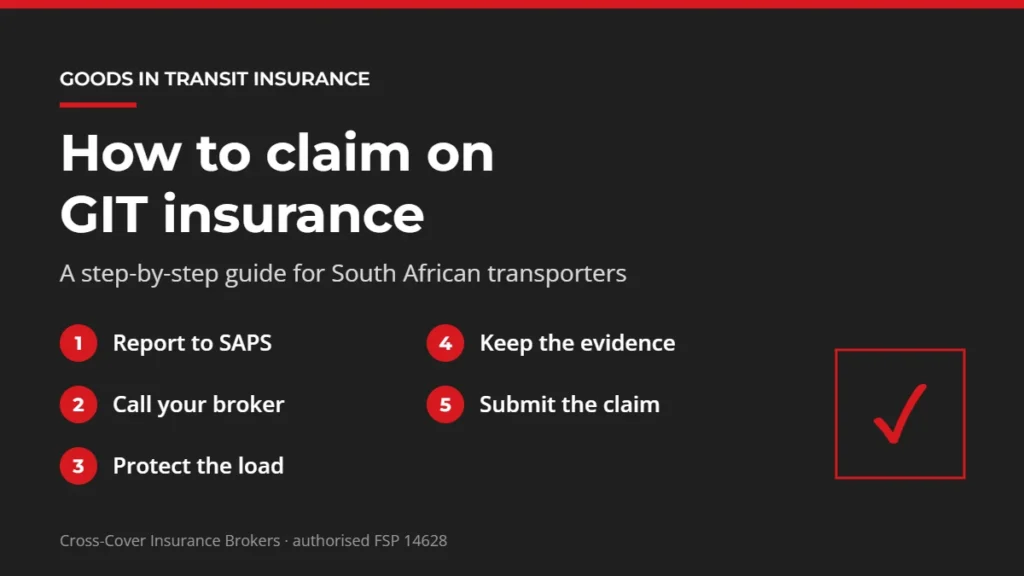
If a load is stolen, hijacked or damaged: make everyone safe, report theft or hijacking to SAPS and get a case number, tell your broker straight away, protect what is left of the load, and collect the evidence, including photos, delivery notes, tracking data and the driver’s statement. Then submit the claim form with the documents the insurer asks for. The faster and more complete your paperwork, the faster your goods in transit (GIT) claim can be settled.
Ten steps after a loss
1. Make the scene safe
People come first. Move to safety, call emergency services if anyone is hurt, and never confront hijackers.
2. Report to SAPS and get a case number
Report theft or hijacking at the nearest police station as soon as possible. Insurers normally need the SAPS case number, and the Road Freight Association notes that many hijackings are reported only because insurers require one. Accidents must also be reported to the police, usually within 24 hours, which gives you an accident report (AR) number.
3. Tell your broker immediately
Call your broker before you do anything that could affect the claim, such as moving, selling or dumping damaged goods. Your policy sets a deadline for notifying claims, so do not wait until you have every document. Cross-Cover clients can call Justin Cripps on 083 357 5553.
4. Tell the cargo owner
Let your client know what happened and what you are doing about it, and keep a written record of the conversation.
5. Protect what is left
Take reasonable steps to stop the loss getting worse: transfer undamaged goods to another vehicle, secure the truck and trailer, and keep reefer units running. Insurers expect this, and many policies contribute to the reasonable cost of doing it. Keep every receipt.
6. Collect the evidence
Photograph the scene, the vehicle, the load and the seals. Download the tracking report for the trip. Keep the delivery note or waybill, the invoices that prove the value of the goods, and a written statement from the driver.
7. Complete the claim form
Fill in the insurer’s claim form accurately and completely. Send the supporting documents together if you can, because missing paperwork is the most common cause of delay.
8. Work with the assessor
For larger losses, the insurer may appoint an assessor to inspect the vehicle, the goods or the site and to interview the driver. Give access, answer questions honestly, and keep any salvage until the insurer agrees it can be disposed of.
9. Settlement
Once the claim is accepted, the insurer pays the value of the goods, up to your load limit, less your excess. If the load was worth more than your limit, the difference is yours to carry. Our load limit guide explains how to avoid that.
10. Learn from it
Review what happened with your broker and your drivers. Fix the gap, whether it was a route, a stop, a security condition or a loading procedure, and check your load limit and conditions before renewal.
Documents checklist
| Document | Why the insurer needs it |
|---|---|
| SAPS case number or AR number | Confirms the incident was reported to the police |
| Delivery note or waybill | Shows what was loaded, for whom and when |
| Invoices or other proof of value | Confirms what the goods were worth |
| Tracking report | Shows the route, the stops and the time of the incident |
| Driver’s statement, licence and PrDP | Explains what happened and shows the driver was properly licensed |
| Photos of the scene, load and seals | Shows the damage and the condition of the load |
| Towing and salvage records | Shows what was recovered and what it cost |
| Completed claim form | The formal claim |
What slows a GIT claim down
- No SAPS case number for a theft or hijacking
- Late notification to the broker or insurer
- No proof of the value of the goods
- A security condition that was not met, such as an unattended truck or an inactive tracker
- A commodity that was never declared to the insurer
- A load worth more than the load limit
Most of these can be prevented before a loss. Our guide to why GIT claims get declined explains how.
Frequently asked questions
As soon as possible. Your policy sets the deadline for notifying the insurer, and theft or hijacking should be reported to SAPS immediately.
For theft and hijacking, insurers normally require a SAPS case number. For accidents, you will usually need the accident report (AR) number.
It depends on the size of the loss and how complete your documents are. Claims with full paperwork move fastest, and large losses may need an assessor.
Yes, the policy excess applies to each claim unless you have an excess reducer. Theft and hijacking can carry a different excess.
Tell your broker. Recovered goods reduce the claim, and the insurer may take over the salvage after paying the loss.
Related reading
- Why GIT claims get declined
- Top risks to goods in transit
- Proof of goods in transit insurance
- GIT insurance explained
Sources
- Freight News: Truck hijacking decline masks under-reporting (RFA), 1 September 2026
This article is general information, not financial advice. Claims are assessed under your policy wording. Cross-Cover Insurance Brokers is an authorised financial services provider (FSP 14628).